
Biomass—renewable energy from plants and animals
Biomass is renewable organic material that comes from plants and animals. Biomass can be burned directly for heat or converted to liquid and gaseous fuels through various processes.
Biomass was the largest source of total annual U.S. energy consumption until the mid-1800s. In 2025, biomass accounted for about 5% of U.S. total primary energy consumption.1 Biomass is used for heating and electricity generation and as a transportation fuel. Biomass is an important fuel in many countries, especially in developing countries for cooking and heating.
Biomass sources for energy include:
- Wood and wood processing waste—firewood, wood pellets, and wood chips, lumber and furniture mill sawdust and waste, and black liquor from pulp and paper mills
- Agricultural crops and waste materials—corn, soybeans, sugar cane, switchgrass, woody plants, algae, and crop and food processing residues, mostly to produce biofuels
- Biogenic materials in municipal solid waste—paper products; cotton and wool products; and food, yard, and wood wastes
- Animal manure and human sewage for producing biogas (renewable natural gas)
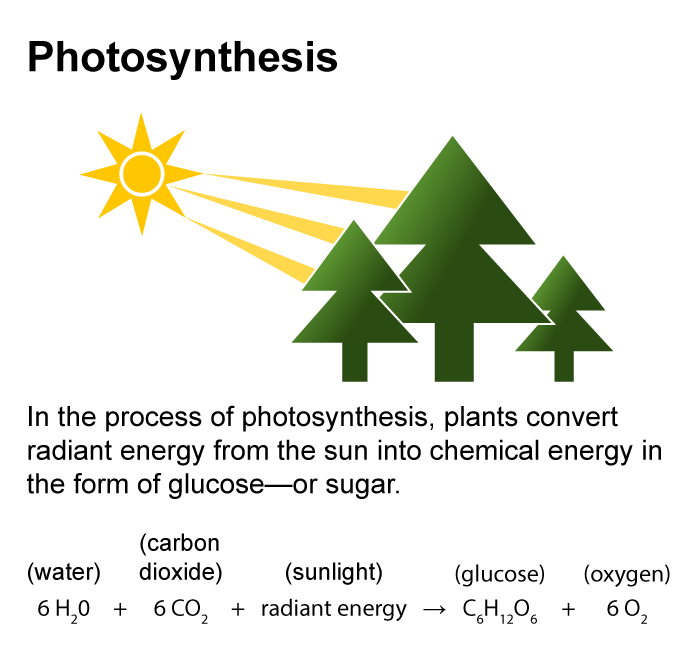
Source: Adapted from The National Energy Education Project (public domain)
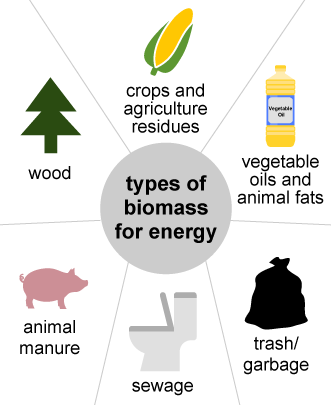
Source: U.S. Energy Information Administration (public domain)
Biomass can be converted to energy in different ways
Biomass is converted to energy through various processes, including:
- Direct combustion (burning) to produce heat
- Thermochemical conversion to produce solid, gaseous, and liquid fuels
- Chemical conversion to produce liquid fuels
- Biological conversion to produce liquid and gaseous fuels
Direct combustion is the most common method for converting biomass to useful energy. All biomass can be burned directly for heating buildings and water, for providing industrial process heat, and for generating electricity in steam turbines.
Thermochemical conversion of biomass includes pyrolysis and gasification. Both processes are thermal decomposition processes where biomass feedstock materials are heated in closed, pressurized vessels called gassifiers at high temperatures. The processes mainly differ in the temperatures and in the amount of oxygen present during conversion.
- Pyrolysis involves heating organic materials to between 800° F and 900° F (400° C and 500° C) in the nearly complete absence of free oxygen. Biomass pyrolysis produces fuels such as charcoal, bio-oil, renewable diesel, methane, and hydrogen.
- Hydrotreating uses hydrogen to process bio-oil (produced by fast pyrolysis) under elevated temperatures and pressures in the presence of a catalyst to produce renewable diesel, renewable gasoline, and renewable jet fuel.
- Gasification involves heating organic materials to between 1,400° F and 1,700 F (800° C and 900° C) in a vessel and injecting controlled amounts of free oxygen or steam into the vessel to produce a carbon monoxide- and hydrogen-rich gas called synthesis gas or syngas. Syngas can be used as a fuel for diesel engines, for heating, and for generating electricity in gas turbines. When the hydrogen is separated from the syngas, the syngas and the hydrogen can be burned or used in fuel cells. The syngas can be further processed to produce liquid fuels using the Fischer–Tropsch process.
A chemical conversion process known as transesterification is used for converting vegetable oils, animal fats, and greases into fatty acid methyl esters (FAME) to produce biodiesel.
Biological conversion of biomass includes fermentation to make ethanol and anaerobic digestion to produce biogas. Ethanol is used as a vehicle fuel. Biogas, also called biomethane or renewable natural gas, is produced in anaerobic digesters at sewage treatment plants and at dairy and livestock operations. Biogas also forms in and may be captured from solid waste landfills. Properly treated renewable natural gas has the same uses as fossil fuel natural gas.
Researchers are working on ways to improve these methods and to develop other ways to convert and use more biomass for energy.
Biomass provided about 5% of U.S. energy in 2025
In 2025, biomass accounted for about 5% of U.S. energy consumption, or about 4,853 trillion British thermal units (TBtu). The types, amounts, and the percentage shares of total biomass energy consumption in 2025 were:
- Biofuels—2,569 TBtu—53%
- Wood and wood waste—1,912 TBtu—39%
- Municipal solid waste, animal manure, and sewage—372 TBtu—8%
The industrial sector is the largest consumer of biomass for energy in the United States
The amounts—in TBtu—and percentage shares of total U.S. biomass energy use by consuming sector in 2025 were:
- Industrial—2,317 TBtu—48%
- Transportation—1,683 TBtu—35%
- Residential—372 TBtu—8%
- Electric power—318 TBtu—7%
- Commercial—163 TBtu—3%
The industrial sector accounted for the highest total annual U.S. biomass consumption in 2025 in terms of energy content and percentage share. The wood products and paper industries use biomass in combined heat and power plants for process heat and to generate electricity for their own use.
The transportation sector accounted for the second-highest amount and percentage share of biomass (as biofuels) consumption in 2025.
The residential and commercial sectors use firewood and wood pellets for heating. Commercial sector biomass consumption includes biogas produced and consumed by municipal sewage treatment facilities and waste landfills.
The electric power sector uses wood and biomass-derived wastes to generate electricity for sale to the other sectors.
The United States is a net exporter of biomass energy
On an energy content basis, U.S. total biomass energy exports exceeded total biomass energy imports in 2025.
Densified biomass fuels (wood pellets and other densified biomass fuels) have become a U.S. export commodity in recent years. In 2025, the United States exported about 9.4 million tons of wood fuel pellets (Table 8).
1 Source: Monthly Energy Review, May 2026. Data for 2025 are preliminary.